
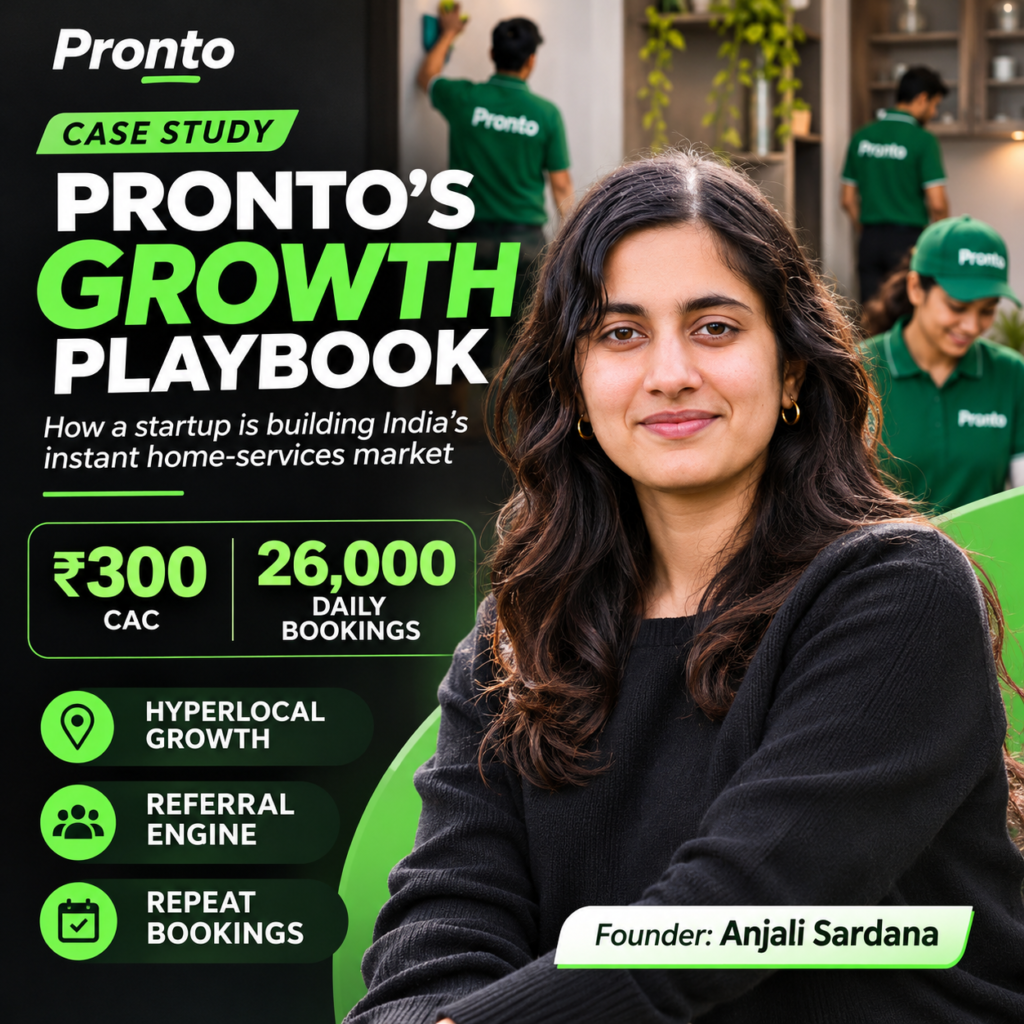
Most startups spend millions trying to acquire customers. Additionally, Pronto found a way to turn neighborhoods, referrals and repeat bookings into one growth engine.
₹300 customer acquisition cost. Twenty-six thousand daily bookings. One hundred ninety micromarkets.
However, the most interesting part of Pronto’s growth is the connection between acquisition and referrals.
It shows how one approach linked customer acquisition, workforce referrals, and hyperlocal marketing to create a new service experience.
We can outline the marketing playbook behind Pronto.
Pronto: How Did They Market and Grow a Home-Services Startup in India?
The interesting thing about Pronto is that it isn’t just selling cleaning services.
Moreover, it is organizing one otherwise fragmented household-services market and making domestic help more accessible, reliable and professional.
From a marketing perspective, I would study Pronto.
Specifically, it spans five areas.
- Brand positioning
- Customer acquisition
- Trust-building
- Supply-side marketing (attracting and retaining workers)
- Hyperlocal expansion
The screenshot gives us some useful company context. However, it doesn’t reveal the actual campaign mix or customer acquisition costs. Let’s distinguish the reported growth story from the marketing tactics we can verify.
Their Actual Marketing Strategy: What the Research Reveals
A. Performance Marketing Is a Major Growth Engine
However, according to Sensor Tower, Pronto has relied heavily on paid acquisition.
- Paid Display contributed approximately 28% of its app downloads.
- Its advertising spend increased more than 600 times year over year.
- Advertising impressions increased approximately 610 times.
- The increase in visibility coincided with Pronto becoming the most-downloaded app in its category.
Marketing lesson: They are not relying only on organic word of mouth.
Additionally, they are aggressively buying visibility while the category is still developing.
Additionally, they market to two different audiences.
In particular, this is interesting.
Moreover, it is particularly noteworthy.
Acquisition grows.
- Convenience
- Quick availability
- Reliable household help
- Quality and trust
Worker acquisition
- Predictable earnings
- Shift-based work
- Training
- Safety and professional identity
Additionally, Pronto calls its service providers professionals or “Pros”.
Its founder has highlighted worker referrals as an important acquisition channel. Additionally, in March 2026, she said the company’s worker experience and professional satisfaction were generating referrals.
This is a clever strategy. Additionally, it markets the platform to customers while also promoting the opportunity to workers.
Hyperlocal marketing rather than citywide expansion.
Additionally, Pronto focuses on building density in neighborhoods.
Its reported operating model uses small micromarkets, typically around 1.5–2 km in radius. Some clusters reportedly generate more than 500 bookings per day.
Indeed, why does this matter?
Rather than spending money acquiring customers across an entire city, they concentrate demand in selected neighborhoods.
They also focus supply there.
Moreover, this improves service availability.
It also boosts worker utilization and increases the potential for repeat bookings.
D. Referral Marketing and Incentives
On both sides, the referral strategy operates. Additionally, it drives referrals on both sides.
- Existing workers introduce new workers.
- Existing customers can potentially generate word-of-mouth demand.
- Worker referral incentives help expand supply.
Additionally, a March 2026 funding report identified worker referrals as the largest professional onboarding channel.
Moreover, the brand positioning centers on speed and reliability.
Pronto is competing in the instant home-services category.
Its core promise is not simply cleaning. Additionally, it is access to household help when you need it.
Additionally, this changes the customer’s perception from:
So I need to find a maid.
Additionally, please clarify the recipient.
I can book household help through an app.
Moreover, this is category creation, not merely service advertising.
2. The Numbers That Reveal Their Growth Strategy
This is an especially interesting finding. Additionally, it comes from Mint’s May 2026 report.
The customer acquisition cost is ₹300.
Reportedly, largely through performance marketing.
We allocate sixty percent to new worker onboarding.
Reports indicate it is coming through referrals.
190 – Micromarkets
The report covered 10 cities.
There are 26,000 daily bookings.
Reported in May 2026.
These numbers reveal something important.
Pronto has managed to make customer acquisition relatively inexpensive.
However, its bigger challenge is recruiting enough service professionals.
3. What I Would Learn from Pronto as a Digital Marketer
| Marketing element | Pronto’s approach | Business lesson |
|---|---|---|
| Positioning | Instant house help | Sell convenience |
| Paid advertising | Aggressive performance marketing | Capture demand quickly |
| Referral marketing | Worker referral incentives | Turn people into acquisition channels |
| Local marketing | Neighbourhood-level density | Dominate small markets first |
| Retention | Repeat household bookings | Build habits |
| Trust | Verified and trained professionals | Make trust part of the product |
One particularly interesting metric: TechCrunch reported that the median time between a customer’s first and second booking was just two days in March 2026. This suggests strong repeat usage.
4. My Proposed Marketing Strategy If I Were Handling Pronto
I would introduce something beyond conventional Google and Meta advertising.
My Recommended Growth Experiment
The 2-KM Neighborhood Domination Strategy
Imagine Pronto entering a new Hyderabad neighborhood.
Instead of running advertisements across the entire city:
- Identify apartment communities within a 2-km radius.
- Create dedicated campaigns for each residential community.
- Partner with apartment associations and resident welfare groups.
- Offer first-booking trials to selected households.
- Run WhatsApp referral campaigns among residents.
- Use customer testimonials and actual service demonstrations.
- Retarget people who visited the booking page but didn’t book.
- Expand to neighboring communities once service availability is reliable.
The objective is to make Pronto a familiar household brand within a small geographic area before expanding.
An Additional Idea
Create a neighborhood ambassador program. Give existing satisfied customers referral credits for introducing Pronto to other households in their apartment complex.
This can combine local trust with measurable customer acquisition.
5. What Competitors Can Learn from Pronto
Urban Company
Established brand awareness. Strong organic discovery.
Snabbit
Strong user engagement and frequent usage.
Pronto
Moreover, aggressive paid acquisition drives rapid download growth.
The Biggest Takeaway
I think Pronto’s most interesting marketing achievement is not its advertising budget.
It is the way it combines three growth engines:
Customer Acquisition
Paid advertising + performance marketing
Supply Acquisition
Worker referrals + incentives
Geographic Density
Neighborhood-level expansion + repeat bookings
Scalable Growth Engine
My conclusion: Pronto is a great example of how marketing, operations, technology and customer experience must work together. Advertising can bring the customer, but operational excellence makes that customer return.
Sources for Further Study
- Sensor Tower – India’s Home Services Apps: Pronto vs Urban Company vs Snabbit
- Mint – Pronto’s ₹300 customer acquisition cost and referral strategy
- TechCrunch – How Pronto scaled its instant home-services business
- Fortune India – Anjali Sardana’s business and operating model
Pronto Didn’t Just Build a Home Services App. It Built a Hyperlocal Customer Acquisition Machine. This could be an excellent case study for digital marketers and startup founders.